
Baltimore City Arrest Records and Charges
Arrest records and court charge records are related, but they are not the same file. An arrest record can reflect the law-enforcement event, booking, custody routing, and identifying information held by police, sheriff, or correctional systems. A court charge record reflects the allegation filed in court after the arrest or charging decision. In Baltimore City, that filing may appear in District Court of Maryland District 1 or Circuit Court for Baltimore City, depending on the offense level and case path.
The Baltimore City Sheriff's Office provides court security, civil enforcement, domestic violence resources, eviction services, and law-enforcement support, but no official public sheriff-run mugshot or arrest-search database was located in the official sources used here. Custody lookup starts with DPSCS for covered people in custody. The charge list and charge status generally come from the court case. For the complete case file, pleas, disposition, and sentence, use the Baltimore City criminal court records route.
Find Baltimore City Arrest Records
A practical search starts by deciding which side of the event is needed. For court charges after arrest, use Maryland Judiciary Case Search and confirm the court, case number, charges, docket entries, and disposition. For custody location, use the Maryland DPSCS Incarcerated Individual Locator when the person is covered by that system. For agency arrest reports or administrative law-enforcement records, a Maryland PIA request may be needed, subject to denials and redactions.
- Search the official court case portal by defendant name or case number.
- Confirm whether the case is District Court or Circuit Court.
- Open the charge list and read every count separately.
- Check current charge status, later docket entries, and final disposition.
- Use DPSCS only for custody-location questions, not as the court charge source.
Statewide criminal-history records and police records are different from a court charge record. The Maryland State Police Central Records Division is the official state police route for criminal-history and crash-report channels identified in the research, while the court docket remains with the Maryland Judiciary.
Baltimore City Charges After Arrest
Charges can be initiated through police or commissioner action and then prosecuted by the Office of the State's Attorney for Baltimore City. The State's Attorney title is used in Baltimore City, not district attorney. The prosecutor reviews charges, prosecutes criminal cases, and may amend, reduce, proceed on, or decline charges. The public defender or private counsel represents defendants, but defense counsel is not the public record source.
| Document | Who Uses It | What It Does |
|---|---|---|
| Complaint or Statement of Charges | Often officer, commissioner, or prosecutor routed | Starts or supports a District Court criminal case and lists allegations. |
| Information | Prosecutor | Files formal charges without a grand-jury indictment where allowed. |
| Indictment | Grand jury process | Formal felony charging document often used for serious Circuit Court matters. |
The manifest image from the Office of the State's Attorney for Baltimore City supports the local prosecutor role in charge filing and prosecution.

The prosecutor source helps explain why a charge can change after arrest and before final disposition.
Baltimore City Charge Status
Charge status is the key difference between an arrest event and a court charge record. One arrest can produce no filed court case, one charge, or several counts. Those counts can move in different ways. A charge may be pending, amended, reduced, dismissed, placed on stet, ended by nolle prosequi, resolved by plea, tried, or followed by sentencing. Later docket entries can matter more than the first charge name.
| Status | What It Means |
|---|---|
| Pending | The charge remains active or unresolved in the court case. |
| Amended / Reduced | The original allegation changed, often to a different offense, count, or severity. |
| Dismissed | The court ended the charge without a conviction on that count. |
| Nolle Prosequi | The prosecutor decided not to proceed on the charge. |
| Stet | The case or charge was placed on an inactive docket subject to conditions and possible reopening. |
| Probation Before Judgment | A Maryland disposition that may avoid a conviction if conditions are met. |
Baltimore City Charges vs Convictions
Being charged is not the same as being convicted. Court charges after arrest are allegations filed in a criminal case. A conviction requires a guilt-based court outcome, such as a guilty plea or guilty verdict. A Baltimore City charge record may include dismissed, nolle prosequi, stet, not guilty, or probation before judgment entries. Each count must be read on its own line.
| Point | Charge | Conviction |
|---|---|---|
| Meaning | Formal allegation filed with the court | Guilt-based court outcome |
| Timing | Appears early after arrest or filing | Appears after plea, trial, or qualifying disposition |
| Can Change | May be amended, reduced, dropped, or dismissed | May lead to sentence, probation, appeal, or post-case relief |
| Search Risk | Can be mistaken for guilt if read alone | Must still be checked for expungement, appeal, or later modification |
Prosecutor and Defender Roles
The Maryland Office of the Public Defender provides representation to eligible indigent defendants and has district-office services for Baltimore City. The public defender does not provide public case records. Its role is defense representation. The State's Attorney prosecutes criminal cases and makes charging decisions, while the court maintains the public docket and case file.
The manifest image from the Maryland Office of the Public Defender marks the defense side of Baltimore City criminal charge proceedings.

The defense source is relevant to charges after arrest, but record searches still route to court and agency systems.
Federal Arrest and Charge Records
Some Baltimore City arrests or investigations become federal cases. Those records do not appear in Maryland Judiciary Case Search. Federal criminal dockets and filings route through the U.S. District Court for the District of Maryland, CM/ECF, PACER, the U.S. Attorney's Office, and sometimes the U.S. Marshals Service or federal detention channels. Local DPSCS custody lookup may not cover every federal defendant.
The manifest image from the U.S. District Court for the District of Maryland supports the federal court route for Baltimore City charge records outside state court.
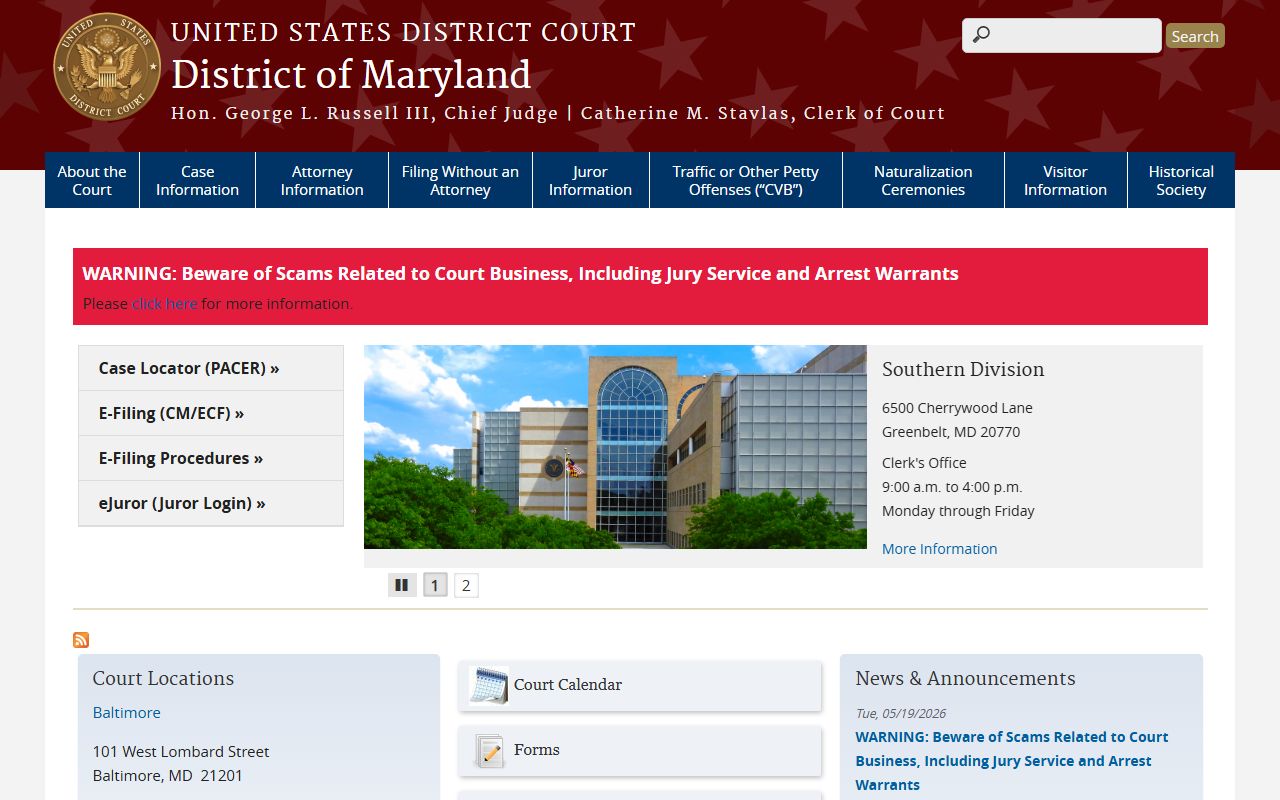
Federal district court access is separate from Maryland state court access, even when the arrest or investigation occurred in Baltimore City.
The manifest image from the U.S. Attorney's Office for the District of Maryland reflects the federal prosecutor role.
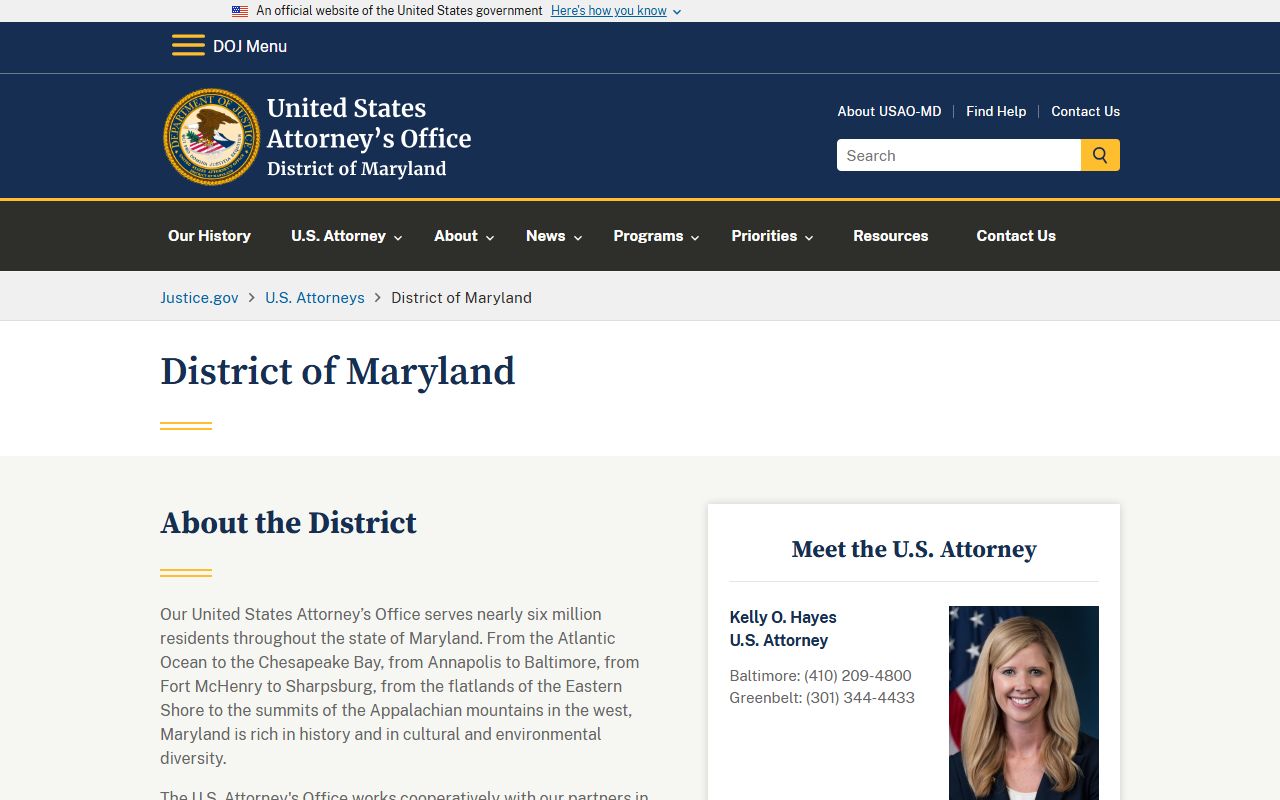
The U.S. Attorney source matters only for federal charges, not ordinary Baltimore City District Court or Circuit Court cases.
Restricted Baltimore City Charge Records
Charge records can be restricted for several reasons. Juvenile matters are not ordinary public criminal files. Sealed records may require a court order or statutory authority to view. Expunged records may be removed from public Case Search and ordinary inspection. Adoption, mental health, protected addresses, minors' identifiers, medical details, Social Security numbers, and financial account data are restricted or redacted when law or rule requires it.
| Point | Sealed | Expunged |
|---|---|---|
| Public Visibility | Restricted from public view by rule or court order | Removed from ordinary public inspection when granted |
| Effect on Search | May hide entries, documents, or the entire case | May make the charge unavailable through public lookup |
| Reason | Confidential case type, protected details, or court order | Qualifying disposition and statutory process |
| What to Do | Ask the court about access authority | Use Maryland expungement guidance and court process |
The manifest image from Maryland Criminal Procedure section 10-101 supports the expungement definitions used for charge records.
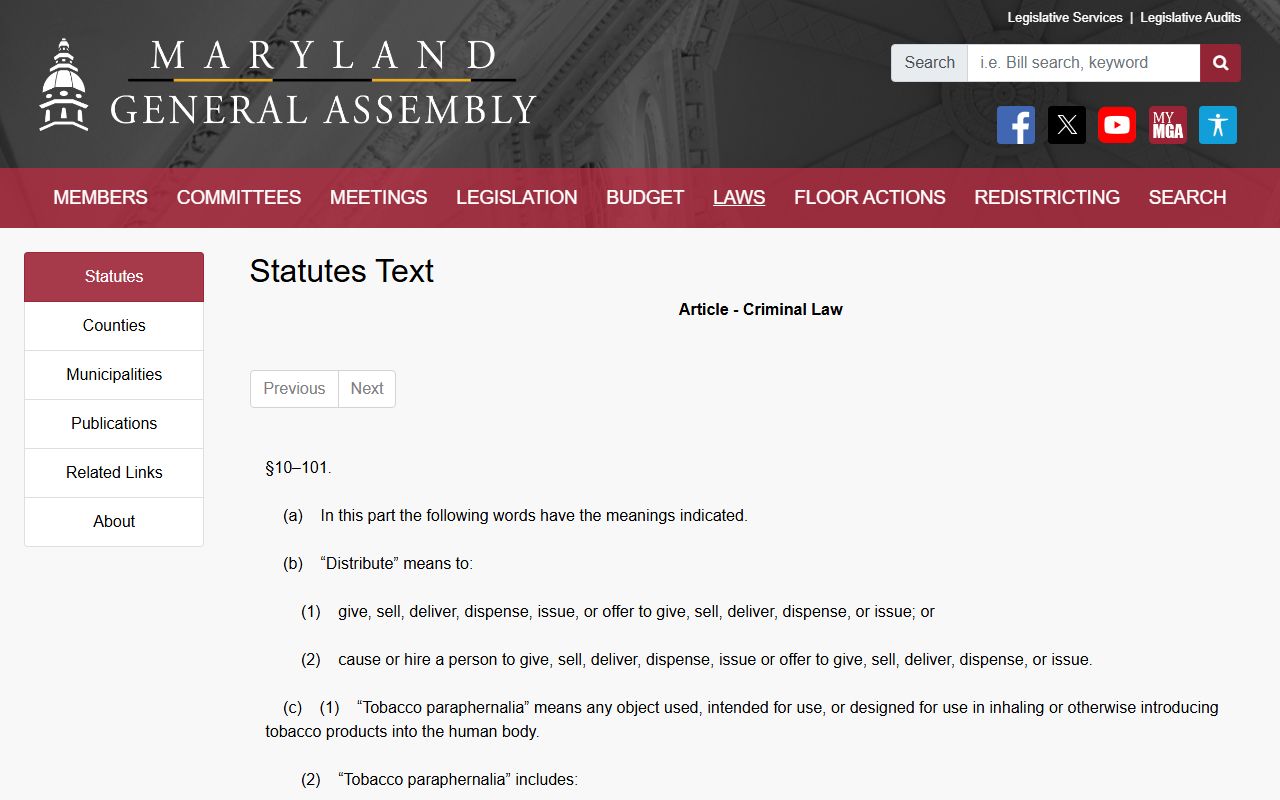
Those definitions matter because expungement can affect both police records and court records after eligible dispositions.
Important: A missing charge may reflect expungement, sealing, wrong court level, misspelled name, or no filed court charge.
Baltimore City Arrest Record Limits
Maryland Public Information Act section 4-201 provides a general inspection right for public agency records, and section 4-301 requires denial when a statute, court rule, or court order bars inspection. That distinction is important for Baltimore City arrest records. A law-enforcement arrest report may be an agency record subject to PIA analysis. A court charge record follows court access rules. A custody location follows DPSCS rules. A federal charge follows federal systems.
Do not rely on third-party arrest or warrant sites for official status. Use Case Search for court charges, the correct clerk for copies, DPSCS for covered custody lookup, the State's Attorney or defense counsel for case-role questions, and official police or emergency channels for urgent public-safety issues. The public view may lag, omit protected details, or show charge history that later changed.